

Schwarzman Centre becomes Europe’s largest Passivhaus university building and world’s first Passivhaus concert hall
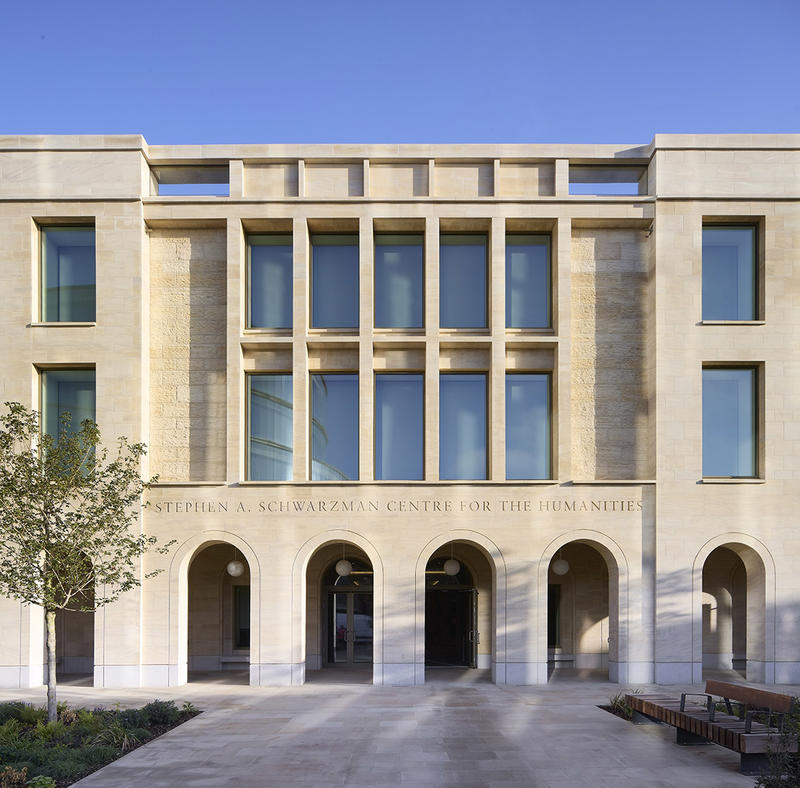
The University of Oxford's Stephen A. Schwarzman Centre for the Humanities has officially achieved certification to the Passivhaus building standard for very-low-energy construction.
The Centre, which opened to the academic community in October 2025, is a major new development which has been made possible by a gift of £185 million from philanthropist and businessman Stephen A. Schwarzman. It brings together seven of Oxford’s internationally recognised Humanities faculties, as well as two research institutes, a new library, performance spaces, and more.
The Passivhaus Institute has now confirmed that the Centre is the largest Passivhaus certified university building in Europe and the world’s first Passivhaus concert hall. Receiving this certification requires exceptional levels of performance across multiple criteria, including insulation, airtightness, manufacture, heating and cooling, energy, glazing, ventilation, and more.
Professor William Whyte, Senior Responsible Owner for the Schwarzman Centre building project said: “This is a stunning achievement by the designers and builders of the Schwarzman Centre. For a project of this scale and complexity to be awarded Passivhaus certification is also a testament to the commitment of the university to reach its bold environmental sustainability targets. It has been a privilege to work with a team of such remarkable professionals."
Will South, Passivhaus Designer for Etude who worked on the Schwarzman Centre project, said: “The major challenge for achieving Passivhaus on this building was managing the heat loss from the complex ventilation system, whilst providing exceptional air quality to the varying occupancy and use of the building. The server, AV and IT systems also presented challenges in meeting the energy efficiency targets, not to mention the scale and sheer number of data points”.
The citation from Passivhaus Certifier Laszlo Lepp of the Passivhaus Institute said: “The design, construction and commissioning of such a large building with complex usage requires an extraordinary team effort. This team spirit and high level of motivation of all those involved was clearly noticeable from the beginning to the end and was an essential part of the quality achieved. I am delighted to confirm that the high-quality standards required for Passivhaus certification have been met in this project."
The achievement of Passivhaus certification was made possible by the University of Oxford, CPC Project Services, Hopkins Architects, Etude, Max Fordham, Arup, and the project’s main contractor Laing O’Rourke and their supply chain.
To accomplish the projects' insulation, airtightness and programme goals the external envelope is fully panelised and prefabricated. This was realised using a Digital Build strategy, to technically verify and resolve all interface details, before Modern Methods of Construction were utilised to manufacture and assemble the façade off-site to exacting quality and performance standards.
To achieve Passivhaus certification at this scale, a custom quality management process was developed, using in-house Laing O'Rourke quality assurance procedures, to verify and record construction integrity at every stage of installation. This helped the team maintain certainty of information and responsibilities on site, across multiple parties, while maintaining the pace of construction.
The project achieved a final building airtightness test of 0.66 m3/m2/h @50Pa (0.16ach), with an external envelope average weighted U-value of 0.30 W/(m²K) comprising, 'solid' wall elements of 0.16 W/(m²K) and a roof of 0.12 W/(m²K).
A bespoke assessment criteria for Primary Energy was used by the Passivhaus Institute to certify the building. On commissioning the systems performed better than expected and, coupled with very high performing glazing systems, brought the space heating demand to less than 8kWh/m2/y. The small amount of heating and cooling still required by the building is provided by separate roof mounted air source heat pumps and chillers.
Early performance monitoring over this winter has already demonstrated that the centre’s heating system requires approximately half the energy of similar non-Passivhaus buildings on a pro rata basis.

